• A few days after school let out for the summer, I received an Instagram message from a student who had just graduated. Her exact words were: “Mrs. Mohsen. My GOAT. I need a writing prompt.” I emphasize that this is a direct quote. I didn’t particularly care for her tone, but here was a student with double digit absences each semester, one who struggled to turn in assignments on time, if at all, asking me—unbidden—for inspiration to write. Who was I to demand decorum in the moment? I asked this student what she was looking to get off her chest and she didn’t have an answer, so to get her going I shared with her a poem I wrote a few years ago about my relationship with my dad. She responded that poetry isn’t really her thing, so I said, “Sure it is,” and I gave her a few pointers: find an image or a memory of something and describe it with your senses and see what patterns you find and what comparisons you can make to what you are feeling. She said she’d try. So I gave her a prompt: heartbreak. One word. She, in turn, gave me a prompt and we gave each other deadlines. She wrote a poem about a boy who broke up with her—which was beautiful, I might add—and I wrote a poem about my memories of what it was like being 12 years old and we shared with each other five days before our slated deadline. We fawned over each other’s submissions for a few beats and that was that. She ended up deleting her Instagram account and I haven’t spoken to her since, but I’m telling you this because the experience gave me an opportunity to reflect on the benefits of writing that go beyond the walls of a classroom.

    Shortly after my exchange with this student, I remembered a brilliant essay entitled “The Pen and the Scalpel” by a surgeon/writer named Richard Selzer who often writes about his need to reconcile his violent profession as a surgeon with his more human desire to make meaning from his life’s work. Many of his essays, especially those in his anthology entitled The Exact Location of the Soul advocate for the need for individuals to develop a writing practice regardless of their personal or professional identities. Such practices, he argues, help us derive meaning from all of our depleting day to day activities, those confusing events that leave us stranded and disconnected. In “The Pen and the Scalpel,” Selzer compares the medical practice of transillumination—holding a light up to the soft tissue of the body in order to view the insides—with the process of writing. Unlike surgery, transillumination is nonviolent and helps us view the insides of the human body much like writing helps us view our souls. When I gave my student the “heartbreak” prompt, it wasn’t random. I had seen her  during diploma distribution and she had told me that her boyfriend (who was also a student of mine) had broken up with her. My knee jerk reaction in the moment was to minimize the heartbreak and to put it into the context of a life almost 42 years lived. But that wouldn’t have been fair. Breakups, when you’re 17-18, are earth-shattering, all-consuming, world-altering. So I wanted to give her a chance to put these feelings into words. And based on what we discussed via Instagram, I think it worked. This student, through observation and articulation, was able to map out the anatomy of her heartbreak by exercising the literary equivalent of transillumination. I’ll also add that she was able to produce a piece of writing in a form that she said wasn’t really “her thing.”

    Something I’ve known for some time that was solidified for me through this experience is that students crave safe spaces to explore their thoughts. It’s as simple as that. Students—like my Instagram friend/student—are not necessarily inclined to throw themselves headfirst into academic content. What if we could provide a nonviolent and non-punitive pathway? One that allows them to explore the ideas that don’t quite make sense to them yet? In addition to being a pathway to clarity on life’s various personal challenges, I argue that journaling is an excellent way to help students gain access to arcane content areas, to help them make sense of how, say, economics play a role in their lives. No shade to the economics teachers among us, but I’m speaking personally from the perspective of a person who, as a teen, wanted to learn but was never really shown why I should care about—for example—the concept of elasticity. What if we were to offer our students a way in? My point is that I believe all teachers would benefit from a journaling routine in their classes. I realize not everyone has ideas about how to approach such a practice, so allow me to offer a way to incorporate such a thing.

    Last year, I taught creative writing for the first time, and I had a model for writing workshops that worked quite well (I guess for ethos I should also say that not all of my creative writing students cared to be writers): each semester, students were required to submit a 2-4 page piece of writing with a half page summary of (1) their goals for the piece and (2) boundaries for feedback. Students who didn’t want comments about, for example, their grammar were allowed to say they didn’t want comments about their grammar. I did not grade workshop submissions, but I did grade the feedback students gave on other students’ submissions. This is how I monitored students for their adherence to their peers’ boundaries. The final for my class was a revision of the workshop submission with an explanation of how they applied feedback to their revision. I did grade the revisions (and grammar/mechanics did factor in, for anyone wondering). My point is this: I did not have a single student NOT submit a workshop piece. Every single student submitted both semesters, and mostly on time. Even the ones who hesitated because of social anxiety. I attribute this to the boundary-setting apparatus. Students feel vulnerable when they show us their innermost thoughts, but isn’t that really what we want when we are trying to understand why they aren’t getting something we are trying to teach? Or why they are not engaging in the way we would like?

    Because of all of this, I encourage my peers to consider implementing some sort of reflective journal requirement in their classes. Let’s give students an opportunity to say, “Hey, this is what I’m struggling with,” or, “This is how I think I could use this,” or, “Hey, this is a silly anecdote that I was reminded of from our classroom discussion.” At minimum, let’s give students an opportunity to share with us why they aren’t accessing our content and help us see how we might more effectively meet them where they are. I believe the key is allowing students to set boundaries. A practice I’m quite fond of is collecting journals periodically and asking students to put a sticky note on at least one entry that they want me to read. My experience with my creative writing students taught me how important it is to allow students to set boundaries. In their sticky note, they could give guidelines for what comments they do or do not want on their submission(s). Based on my experience, the boundaries create a sense of control that students don’t usually feel in a classroom setting.

    Journaling might seem idealistic or frivolous, but there’s plenty of research that points to the benefits of interdisciplinary journaling as a way to support metacognition, promote lifelong learning, build confidence, and deepen engagement. I’m not trying to get too academic here, but one article I read in the Frontiers in Psychology journal examined outcomes in thousands of classrooms where teachers implemented interdisciplinary journaling and corroborated the benefits, but interestingly, further argued in favor of subject specific journaling prompts. For example, STEM students benefit most from prompts that are much more specific than simply asking them to reflect on this or that. Since STEM classes can be quite technical, the open ended prompts, the researchers found, can feel quite burdensome, but asking students more pointed questions like, “What strategy have I used in learning this topic?” or, “What strategy [in this unit] has given me the biggest challenge and why?” prove to be much more beneficial than more open-ended questions. Humanities classes, too, benefit from specific prompting. Asking students to simply reflect is often much too vague. I think there is benefit in all classes from asking students simple questions like, “What prevents you from concentrating when you work on X,” or “What feelings come up for you when you’re forced to do [insert difficult task] during class?” or “Consider this headline or news article and tell me about the ways you think this applies to what we are learning.” This way, the students are open to sharing their thoughts in an open ended and non-punitive way. Obviously, we have responsibilities as mandated reporters that need to be shared, but I think you’d be surprised at what students are willing to share when they know there is no fear of punishment.

    And students will push back. Ask any English teacher and they will share with you experiences of having students tell them, “I don’t know what to write,” or, “I have nothing to say,” but give it time. Sometimes all you need is a sentence from a student to gain important insights for how you can modify your approach to reach them. I’m also not arguing that we shouldn’t grade writing. We absolutely should assess, grade, and provide feedback on formal writing assignments. But we also need to provide students with opportunities to explore their ideas without fear of penalty. Without commenting on every misplaced modifier, misspelled word, or general mistake. Let them explore the rough edges of a freshly made attempt to make the abstract interiority of their minds and souls more concrete. Sometimes it just needs to be a conversation. Let us be the ones who celebrate when they attempt to gain access to our content areas through any mundane personal connections they may make. So much of our students’ hesitation is rooted in fear. Fear of being wrong. Fear of embarrassing themselves. Let’s provide opportunities for fear not to be a barrier to effort.

    I ended up doing a lot of personal writing this summer as somewhat of a revolt against the AI revolution, but mainly because my experience exchanging poems with my former student reminded me that writing recreationally is something I really enjoy doing and more broadly is really valuable for preserving the human experience. Richard Selzer says that “[t]o write about a patient is like transillumination. You hold the lamp of language against his body and gaze through the covering layers at the truths within.” I cannot think of a better metaphor to describe how powerful the practice of writing is when it comes to coaxing students into passion for our various subject areas. Help them feel connected. Better yet, help them even understand that there is a connection to be made. Any time I write my thoughts about anything—a book I’ve just read, a news article that upsets me, a memory that comes to me—I find myself peeling away layers of confusion and arriving at a place of relative familiarity. I find clarity. Whether it is apparent in the day to day or not, the same is true for the practice of interdisciplinary journaling. Our kids want to learn. They often just do not know how. Through non-punitive writing, let’s invite them in. Let’s allow them to access our content areas through writing. Through reflection,  introspection, and exploration.
  • Do any of you remember that book Sideways Stories From Wayside School by Louis Sachar? It’s a collection of stories about students, teachers, and other staff attending a school that stands 30 stories tall with one classroom on each level. It was meant to be built with 30 classrooms on a single level, but the builder made a mistake during construction. No biggie—the school community adapted. My third grade teacher used to reward our class with read alouds of Sachar’s book on Fridays and my classmates and I would sit—enraptured—as she passionately dictated stories about a kid who wore an infinite number of jackets, a teacher who turned misbehaving kids into apples, a student who couldn’t stay awake, a bouncy ball in a utility closet that no one wanted, a floor that didn’t exist, and other bizarre manifestations. As far as I can remember, every single kid in my class loved those stories. We’d all race in from recess to do our silent reading and practically trample one another to get our hands on that book, mean mugging the person who got to it first. 

    One of the first questions I ask my students when I meet them in August is if they like to read, and if the answer is no, when they stopped enjoying reading. This is, of course, assuming that they once enjoyed books. Most students who answer “no” to the first question have an answer to the second question that resonates with me as a certified bibliophile who has a very personal relationship with the experience of falling out of love with books. Many of their answers remind me of the tragedy that was my sixth grade year. My English teacher—a prototypical evil hag if ever there was one—would not let me read my Fear Street books during silent reading. She never explained why. We had a specific set of dry classics from which we were allowed to choose and don’t you dare ask questions. I continued to read sporadically through middle school, finding a small spark again during ninth grade once I discovered Christopher Pike and devoured practically everything he had written, but I can confidently say that I did not read a single book for pleasure between 10th and 12th grade. Reading was a chore. I noted the signs; I internalized a lesson my teachers likely never meant to teach. Read this. Answer that. Rinse. Repeat. This is not meant to be fun.

    I read a statistic a few months ago that the average American adult reads at or below a sixth grade level. Sixth grade seemed a bit low to me at first, but if you’ve ever been reckless enough (like me) to open the comments on a social media community page post, simple observational analysis can corroborate this startling statistic. Like any well-educated adult, I decided to look into adult literacy further rather than simply relying on my own myopic personal observations to draw such big conclusions.

    A YouGov poll published late last year revealed that about 40% of US adults read precisely zero books in 2025. This is down from the Pew Research poll that revealed about a quarter of US adults read zero books in 2021. Many different surveys, data sets, studies, and anecdotes confirm that the massive decline in reading for pleasure is not just happening among adults—kids are not reading either. This trend of not reading for pleasure doesn’t surprise me, especially considering how often I see someone using a series of commas to indicate an ellipses, capitalizing the first letter of every word in a sentence, not capitalizing anything at all—the list goes on. But poor punctuation is not the big concern here. Let’s be real. Usually people know what you mean if you can give them an approximation of what you are trying to communicate. There are much graver implications to consider when someone doesn’t know how to communicate effectively. Reading for pleasure regularly is directly correlated with increased literacy skills (hello, RLAA certification). And literacy rates are truly at stake here. Beyond literacy rates, but not less importantly, reading helps us cultivate empathy, helps us learn about other cultures, helps us make sense of the human experience, helps us feel heard and seen. Regardless of why you might or might not find reading important, the undeniable fact is that US is experiencing a literacy crisis. Proliteracy.org compiled a fact sheet in 2025 that linked low literacy rates to a significantly increased risks of living in poverty. 59 million American adults cannot read much beyond short and simple sentences, 72 million have numerical literacy skills so low they can do little outside of comparing the number of items in a box to the number of items in a different box, and 68 million have critical thinking skills so low they cannot solve problems that involve more than one step or include any variables. How can anyone live this way? 

    How can we—in our tiny little SCV bubble—do our part to help reverse this nationwide trend?

    It starts with establishing a culture of literacy in our classrooms, on our campus in a much broader sense, and most importantly, it starts with teaching students—modeling to students—how to love books, how books connect with our subject matter and the world with which we all engage on a daily basis. It’s time to start viewing ourselves as shepherds of literacy. 

    I propose we start small and we plant a seed on our campus that helps students connect their reading experiences with joyful memories. Students will be more likely to puzzle through difficult or frustrating reading tasks when reading is already habitual. Students need to see us reading and they need to know that we also connect reading to joy and to leisure. 

    In my classroom, I model a love of reading. I begin on day one by including a picture on my intro slideshow explaining what I read that summer. I summarize my highs and my lows, and I include gritty details about what I learned about myself in each of the books I read. Throughout the year, I constantly tell them what I’m currently reading and I connect what I’m reading to what we are currently learning in class or even just mundane details of weird little connections I’ve made, sometimes even interrupting their carpe librum reading to exclaim “MY GOD, LISTEN TO WHAT I JUST READ!” I’m sure many of my students find my interruptions rude, but some find them entertaining, and when I inevitably leave the book I was reading during my outburst on my shelf with a white board note that reads, “Read this if you ____,” that book inevitably goes missing. And it sometimes comes back, but do you know what? Who cares if it never comes back? Some of my favorite books have gone missing from my classroom and I’ve never seen them again, but it just means that one of my teenagers was interested enough to take it.

    When I teach effective counterarguments, I read excerpts from the nonfiction books I’ve read and I’m like, “SEE!?!! This author does it this way too!” When I find quotes I like, I put them on my white board underneath a title that reads “Quote of the Week,” which many of my students like to point out is more like a quote of the month, but whatever.

    For the past two years, I’ve put a Google form in my classroom stream for students to fill out each time they finish a book, and I buy pizza for the top reader in each class and we eat at lunch together at the end of the year and talk books over pizza (personal pan pizza from Pizza Hut, anyone—‘90s kids?)

    I ask students what they’re reading. I approach individual students and I say, “This book reminded me of you. I think you’d like it.” (By the way, this is my love language, and if I’ve ever approached you personally with a book recommendation, just know that this is the highest compliment I could ever pay a person)

    I’m honest when I don’t like a book. I make my students set goals and create Goodreads accounts. I share Instagram and TikTok bookfluencer (yes—this is a thing) accounts with my students. I let my students know that it’s okay to abandon a book and that life is too short to read a bad book, but also that there’s something for everyone out there.

    Most importantly, free reading (carpe librum) in my classroom is never restrictive and it’s never punitive. You want to read manga (*cringe*)? Please do so. I’m not testing you on the material and I’m never policing your choices. It’s also never assessed. It’s my duty as an educator to find you a book you’ll love. I think back to Mrs. Vossler in sixth grade who sucked every single ounce of fun out of reading for me, and I never want to be that. Let’s all agree that we never want to be the person someone in their 40s remembers and says, “Yep, that’s the person who extinguished my flame.”

    “In this classroom, we love books.” It’s that simple. And it doesn’t have to take much of our class time. We schmooze with students all the time during down time. Why can’t we make this practice centered around the things we’ve learned from the books we’ve read?

    I propose we do a few things as a school community. Why don’t we do a regular “What I’m Reading” segment on Hart TV? Why don’t we use campus bulletin space for teachers to post “books I’ve loved” reflections. My favorite assignment from grad school was compiling a reading autobiography timeline that delineated my most influential books and explained how these books influenced me. Let’s do that. Do we even remember which books we loved as kids? Which books made us readers? Why don’t we reflect? Let’s share these experiences widely across campus. Let’s not let any campus space students encounter be untouched by the books that have touched us. 

    Let’s all commit ourselves to reading more and talking about our experiences with our students. In history, when we read about a protagonist whose conflict centers around some historical event we’ve taught, let’s share that. In math, if there’s a mathematical principle that plays heavily into a conflict that affects a protagonist, let’s share that. I read Emily St. John Mandel’s book Station Eleven about a traveling performance group that keeps stories alive for a society on the brink of extinction. I can’t think of a better metaphor for what AI is doing to us collectively. Let’s share that.

    Let’s do something that keeps passion alive. Most students I’ve met have at least one positive reading experience they can remember. 

    Let’s help them hold onto that.

    My third grade teacher didn’t spark my love of reading, but she certainly fanned the flames for me. My own parents taught me to love books simply by making them constantly available to me as a child, by introducing me to the magical world of The Runaway Bunny (I still try to read this book to my own kids, but they are much too old—insert big sad sigh). My third grade teacher reinforced this love when she allowed me and a horde of fellow barnacle students to sit with her at lunch as she read Garfield comics to us out loud. I learned through my parents and through my third grade teacher that reading is an activity that is fun and that does not have to have strings attached. Many of our students’ parents do not have the time nor the resources for this kind of cultivation, so we must do our part.

    No strings attached.

    Modeled by the people our students look up to.

    Fun.

    The literacy crisis that is sweeping the nation and the world at large does not have to engulf us. We can fan a different flame. 

  • Last month’s CAPS meeting explored effective institutional tier 2 supports: what processes do we have in place for students who do not master essential standards after our best first instruction, and also how are we extending learning for advanced students who need extensions?

    I have been teaching AP English since 2013, so when our speaker, Dr. Luis Cruz asked us to reflect on our extension strategies for advanced and gifted students, I gave myself a mental pat on the back because THIS, this is my wheelhouse. Then…he proceeded to explain what effective extensions are NOT, and I realized I had gotten it wrong. Humbled again. Extension is not: assigning extra work, asking students to teach other students, or *clutches pearls* allowing students to work on assignments from other classes (I am guilty of this one in particular).

    Of course, I knew all of this. I’m sure, deep down, we all know this. I’m not suffering from any delusions that I’m somehow extending student learning when I ask my advanced students in the groups to turn and explain concepts to their peers. But it’s easy—in the melee that is trying to get all students to master essential grade level standards—to neglect the needs of the students in our classes who are ready to move on. Ready to go deeper with their learning. We have so many students in our classes whose learning needs are so significant that in the moment, it’s hard to justify spending extra time on those kids who get it. They’re fine. They’ll be fine. Or so we say.

    As Dr. Cruz continued his presentation, I found myself thinking less about my students and more about my own children. I’m a mom of three elementary aged children. My son is nine and he is a whiz kid (and I don’t use this phrase lightly). Since he was a baby, learning has been exceptionally easy for him. However, my younger daughters (ages four and six) are more typical in their development. My six year old daughter is still learning how to decode whereas my son read Ready Player One when he was that age. My son—however adept he may be at reading—also happens to be a very reluctant reader. Since daily reading is non-negotiable in our household, it’s a constant battle. So my whiz kid son recently discovered a loophole. He has been offering to read to my daughters in the evening “as long as it counts” for his nightly reading. The tired mom in me says, “Yes. Please—I’ve just spent an entire day teaching teenagers. Please read Junie B. Jones to the girls so that I don’t have to.” As Dr. Cruz spoke, I realized that allowing my son to read a book that has a lexile level of about second grade and having it count as his nightly reading is a twofold denial of opportunity for growth. (1) He is not stretching himself as a reader by reading Junie B. Jones and (2) My daughters are not benefiting from listening to the reading of an adult whose cadences and inflections properly model effective reading, which is something I–the English teacher and passionate reader–could do expertly for them. In addition, my son mumbles when he reads out loud, which is kind of just a side note, but also quite important. Why am I telling you this? There’s a saying that a parent is the child’s first teacher, and in these moments, I fear I might be failing to provide my own children with the tools they need to optimize their learning. How can I—a veteran teacher—justify allowing that in my own household? In the same way that I shouldn’t be expecting my (albeit gifted) nine year old son to model effective reading for my daughters, we also shouldn’t be expecting the advanced students in our classes to teach or assess the struggling students among them. It’s simply unfair. 

    To understand what effective extension strategies look like on Hart’s campus, I turned to our resident scientists, Kathryn Smith and Nick Gravel. They’ll need to forgive me when they read my descriptions of their lessons because science was always my least favorite subject in school. Picture this: eyes glazing over. But I’ll do my best.

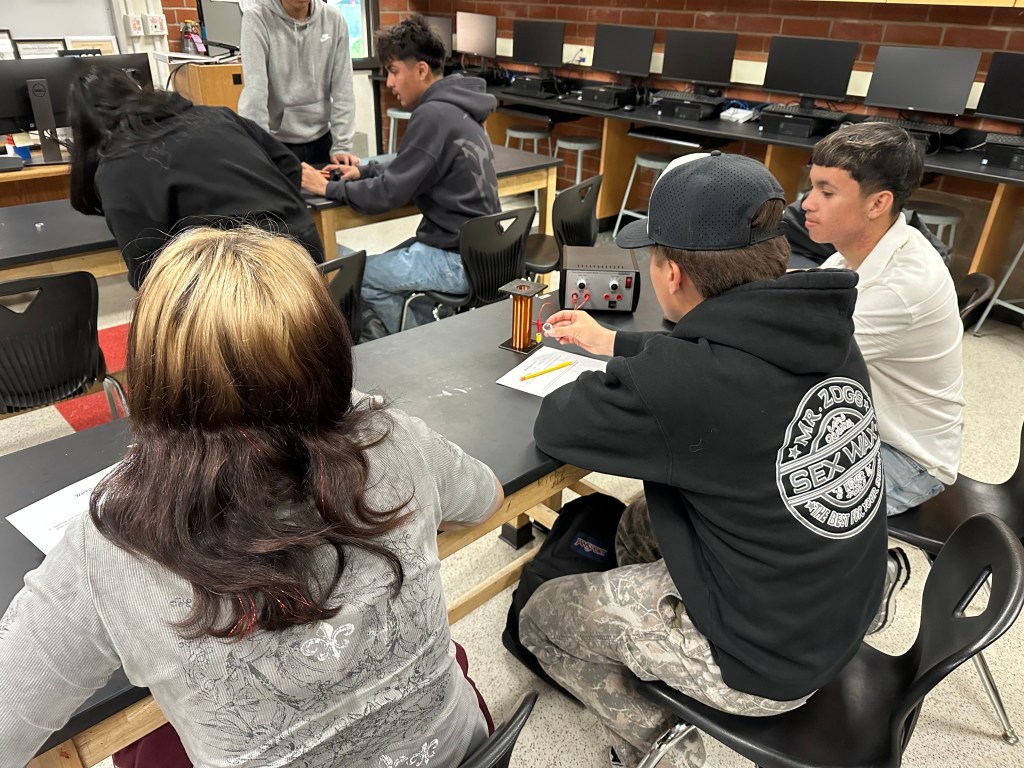
    If you’ve taught at Hart for any length of time, you know that Nick Gravel’s students adore him, which is one of the reasons I chose to observe his class for this blog. On Friday, January 30, Nick had his regular Physics B class studying electric currents with classroom activities centered around the goal of creating magnet fields using a solenoid. *Shoutout to Kathryn Smith for helping me write that description accurately.* The instructions for the activity were to draw the circuit they created, describe what they saw, and explain how it worked, which was an application of what they had learned after several days of lecture. As I sat in Nick’s class, it was apparent to me that there were several students in the class who should really be stretching themselves in AP Physics. For these students, Nick had several extension strategies in place. For one, the activity itself had modifications and extensions built in–students were allowed to explore at their own pace. The advanced students, on several occasions, called Nick over to ask questions that helped them understand the concepts they were learning beyond the scope of the lesson. One student in particular asked several questions that tapped into the WHY of the concept: “Why does it only work for the inside of the magnet?” and “What other factors would affect magnetism?” Additionally, Nick had a pile of electric motors sitting on top of his desk that students had access to if they were ready to move on. These motors used the same scientific principles as the solenoids, but this time to make something move rather than to create a magnetic field. Nick’s lesson highlighted an important principle that I took away from our last CAPS meeting with Dr. Cruz: an important component of MTSS involves considerations for what we do with students who master essential standards quickly. In the same way we must support students who are not mastering essential content, we need to also be providing extensions for students who are ready to move on. This looks like moving students up the Blooms taxonomy pyramid and into the higher levels of the depth of knowledge chart. Nick had already asked students to explain and describe; these are level two skills. Nick’s choice to allow students to make connections, ask why, and compare results moved them up into higher levels of learning.

    Similarly, when I arrived at Kathryn’s class on January 9, I immediately noticed that she (having written what looked to me like hieroglyphics on her board) was having students work within higher levels of thinking. Students were making decisions about which formula to use to measure torque. From there, they had to make decisions about the procedures they needed to use to find numbers to plug into their formulas. As she was teaching, I was wondering how Kathryn would extend learning since the entire lesson seemed to already incorporate the highest levels of Blooms. But if you know Kathryn, you know she always has a plan. Kathryn’s classroom is gamified, which means she has built-in incentives for students who master course content. For students who are ready to move on, Kathryn has skill-aligned AP practice FRQs that students can complete for what she calls quest prizes. The FRQs require students to apply the same skills from the lesson, but this time without step-by-step guidance, which is something the students need to be able to do in order to perform well on the AP exam. I asked one of my journalism students later in the day what Ms. Smith’s quest prizes entail, and she enthusiastically explained them to me, which shows me that there is buy-in. Moving from a guided lesson to an incentivized independent application of learning is again an example of moving students into higher levels of DOK and up Bloom’s pyramid. While Kathryn does have her students strategically grouped by skill level for peer support opportunities, she does not count this as an extension.

    The most complex levels of learning on the Bloom’s Taxonomy pyramid are evaluate and create. I used to ask my son to evaluate the quality of books he finished and then write Goodreads reviews, but at some point between baseball practice and everyday life, we stopped doing this. If you’ve been a parent for any length of time you know that the best laid plans often go awry. I know I need to get back to this practice with him, but it involves time. The same is true for our classrooms. We all want our students to learn at their highest levels, but time is always an issue, and when we have to make sacrifices, we tend to scrape from the top. What I learned from observing Kathryn and Nick is that extensions do not have to take up a tremendous amount of time, just a bit of strategic thinking and a little bit of an Education 101 refresher.

  • An anecdote about authentic assessment

    At last month’s CAPS meeting, our guiding coalition was asked to reflect on the extent to which our team’s gradebooks were an accurate reflection of student learning. That is to say—as a team—do we avoid things like grading on compliance or completion? Can a student with an A in a class honestly say that they’ve mastered grade-level standards for that class? By extension, can we as teachers honestly say that a student who has a D or an F in a class has not grasped grade level standards? It’s in my nature to be a reflective (read: overthinking) person. So naturally, I thought about my own evolution as a teacher. 

    My first four years of teaching were at a school where we were required to input three grades per week—our evaluations depended on it. When I came to Hart in 2017, I was in the habit of blindly putting in X/10 in my gradebook for things like whether or not my students were in uniform each day that week. Wild, right? These were English classes. Can the color of a student’s sneakers reflect how coherently they can defend a thesis? Spoiler: it can’t. I quickly adjusted to the practices my Hart English department colleagues had on the books, and in no time, I felt I could honestly give a bird’s eye look at my gradebook and say that, yes, if a student wasn’t doing well in my class, it was simply because they were not mastering the standards of the course. 

    Fast forward to last month’s CAPS meeting, when our guiding coalition colleague, Zach Koebel shared that his Reach students often feel frustrated by the arcane nature of the weighted grading system. They’d come to him feeling baffled when an assignment worth 100 points barely affected their grade (10% weighted category) while an assignment worth 20 points dropped their course grade by a significant margin (40% weighted category). Cue me, feeling implicated—I have a talent for being able to take everything personally. I had a guilty conscience for a specific grading practice of my own that I knew fit the description of what Zach was discussing. I’ve known for a while that I needed to change one assignment in particular. Be it pride or be it conviction, I never changed. I made moderate adjustments over the years, yes, but I never truly fixed the problem. Please note that I am in no way about to make a case against a weighted grading system. I love a weighted grading system. 

    In addition to being an over-thinker, it’s also in my nature to be completely candid with people regardless of how it makes me look, so here I go, getting vulnerable. 

    I have this assignment in my AP Lang classes that I’m particularly fond of: my podcast challenge. I require students to select a different podcast every quarter and log six hours of listening over the course of ten weeks. I also attach a series of Socratic seminar questions that students respond to via typed responses and then hash out together at the end of each quarter. The seminar questions correspond to the skills we are working on each grading period. The thing is: the assignment is a lot of work, especially when they leave it until the last minute, which high school students are wont to do. And since ChatGPT hit the scene, I’ve had to rethink the way I assess it since so many of the students simply turn to generative AI that they’ve used to do the heavy lifting of the assignment. I ended up making the assignment worth more points, but I entered it into a weighted category that was not worth as much. I guess I truly was trying to trick the students when in 2023 I re-designed the way I graded the assignment: 100 points in the classwork category (10% weighted). I wanted it to feel like the assignment held weight when in reality, I knew it wouldn’t cause a student’s grade to plummet when I inevitably found them to have used ChatGPT to either fill out the log or respond to the seminar questions, or both. 

    This change left students who use the assignment as a learning experience in an unfair position. What if a student struggled all quarter and then felt something click for this assessment? Their grade wouldn’t move an inch even if they earned an A on the assignment. I’ve refused to abandon the podcasts simply because the students who do the project in earnest get so much out of it. Selfishly, I also REALLY enjoy talking to the students about the podcasts they are listening to if they are actually listening to their podcasts. But for every student who gets so much out of the project there is a student who turns in nonsense, or worse, simply cheats. This podcast assignment is a textbook example of me “refusing to kill my darlings,” and now, I find myself looking at not only the way I input the assignment into my gradebook, but also the things I even ask them to do for the assignment. Why was I asking them to answer so many Socratic seminar questions when I really only needed to monitor one or two skills?

    Here is what I have come up with: rather than giving the students all quarter to complete the assignment, I do periodic check-ins. Each check-in is worth a small portion of the overall grade. I recently even began asking the students to complete some of the seminar responses in class. Each quarter, I have six Socratic seminar questions, and not every question entails an essential standard for that quarter. The non-essential standard questions are the ones I now ask them to complete in class. For example, asking students to characterize the rhetorical situation or identify instances of bias. These questions are important, yes, but at this point, they are review, and they do not measure the essential components of what I’ve been teaching. These responses will go into the gradebook at 10%. I’ve decided to make only one of the six questions go into the gradebook at 50%: this quarter it is the question that asks them to identify and respond to a claim made in the podcast. This is the crux of what we’ve been working on. This will allow me to read their responses more deeply. This will allow me to more accurately measure learning based on what I’ve been teaching. 

    Over the years, I’ve been tempted to throw the baby out with the bath water and just go with that which makes my job easier. If so many students complain about the assignment, if it’s also SO MUCH to grade, why not just scrap the assignment completely? Because my podcast challenge is my BABY. It’s an assignment I conceptualized myself and I love it so much. A few years ago I taught the sibling of a student I taught prior to Covid and the mom cornered me during open house and raved that she and her daughter still listen to NYT’s The Daily together even 5+ years after my class, and they get so much out of it. Why would I want to get rid of something that has clearly benefited students so deeply? I do not want to kill my darlings (out of pride) and I also do not want to throw the baby out with the bath water (because of the students who try and therefore benefit), so why not re-evaluate my own grading practices and make the assignment more equitable?

    I realize the solution to my podcast assignment doesn’t fully solve the problem. There will always be capable students who perform poorly in a class because they neglect to turn in assignments. Conversely, we will always have those work horse students whose skills are lacking, but manage to pull off a B in a class. However, taking time to really consider the value of the work I put in front of my students allows me to cut what’s not needed so they can get more out of the essentials. Further, carefully crafting assignment point totals and category weights so that they reflect the difficulty or workload of any given assignment is simply an equitable grading practice.